



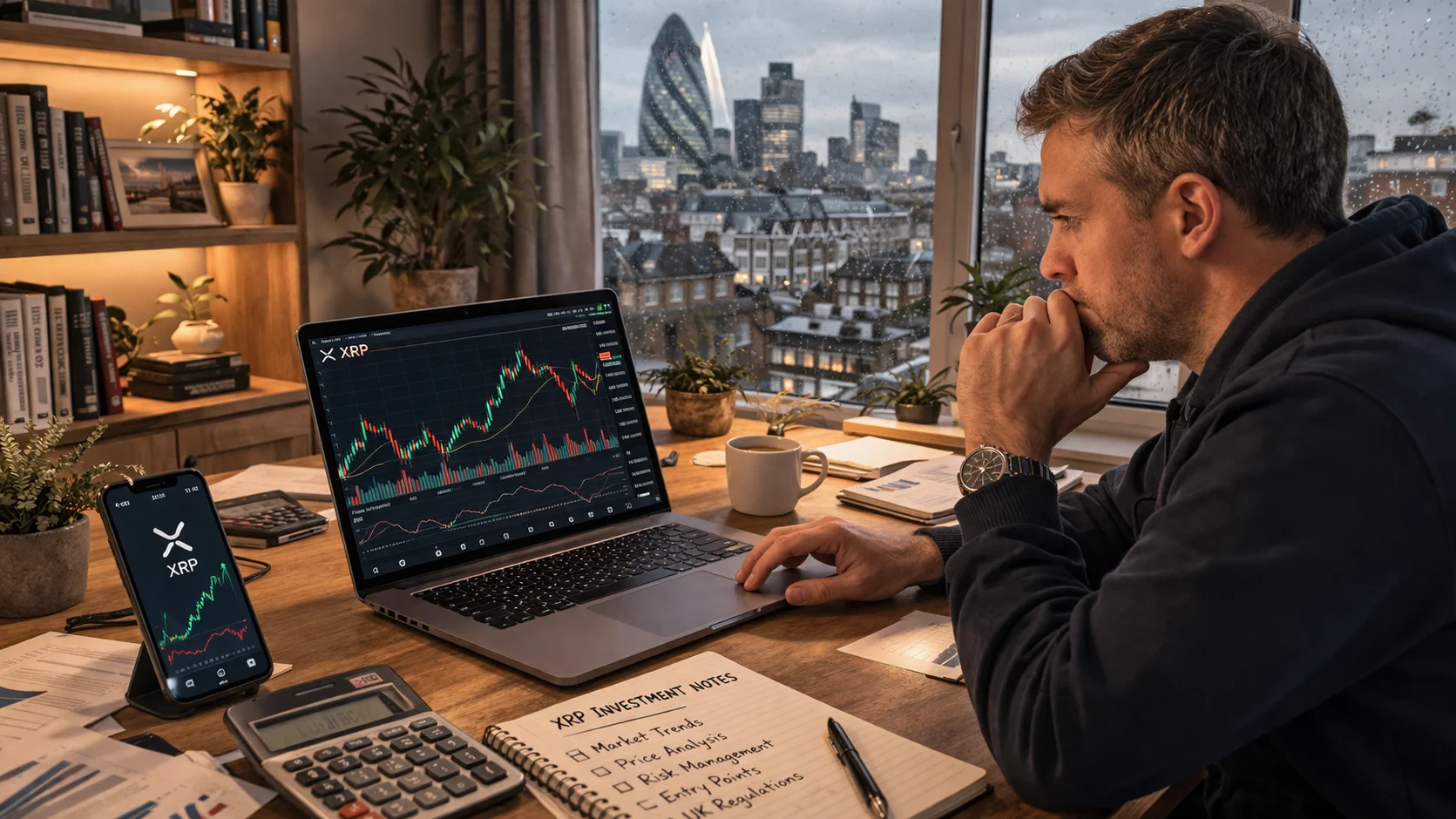
UK Investor Alert: April 2026 Update Is XRP a good investment in 2026, or is it a high-risk asset that could stall your portfolio? As of April 2026, XRP has moved beyond its historical legal hurdles to become a primary focus for UK institutional fintech. However, with 2026 market volatility affecting riskier assets , you must distinguish between “hype” and “utility” before investing.
Quick Decision Matrix:
- Invest if: You have a 5-year outlook and existing low-risk savings.
- Avoid if: You are relying on this money for rent, mortgage, or immediate retirement needs
What Is XRP and Why Are Investors Still Interested in It?

XRP is the digital asset used on the XRP Ledger, a blockchain network created to make international payments faster and cheaper. Unlike Bitcoin, which is often treated as digital gold, XRP was designed to help banks and payment companies move money between countries more efficiently.
Traditional international payments can take several days and often involve high fees. XRP aims to reduce that delay to a few seconds.
Investors remain interested in XRP because:
- It has a practical use case
- Ripple, the company associated with XRP, continues to build banking partnerships
- Legal concerns in the United States have eased compared with previous years
- Some investors believe wider adoption could increase XRP’s value
XRP can settle transactions in three to five seconds and at very low cost, which is why many supporters believe it still has long-term potential.
2026 Institutional Snapshot: In January 2026, Ripple secured a major regulatory milestone by obtaining the Electronic Money Institution (EMI) license from both the UK’s Financial Conduct Authority (FCA) and Luxembourg’s CSSF.
This expanded Ripple’s regulated footprint to over 75 licenses globally. According to a KuCoin 2026 Report, banking integrations in regions like Turkey have seen user growth surge from 14,000 to over 1 million users in less than two years, specifically utilizing XRP for institutional custody.
How Does XRP Compare With Bitcoin and Ethereum as an Investment?
| Feature | XRP | Bitcoin | Ethereum |
| Main Purpose | Cross-border payments | Store of value | Smart contracts and apps |
| Settlement Speed | 3–5 seconds | 10–60 minutes | 15 seconds to several minutes |
| UK Context | Rivals UK Faster Payments | “Digital Gold” for UK high-net-worth investors | Backbone of many UK DeFi applications |
| Primary Risk | Adoption uncertainty | Slower growth | High fees and competition |
Compared with Bitcoin and Ethereum, XRP offers a different type of investment opportunity. Bitcoin is generally seen as the safest cryptocurrency because it has the largest market and the strongest reputation.
Ethereum appeals to investors who want exposure to blockchain technology and decentralised applications.
XRP may have greater upside potential than Bitcoin because it is still more closely linked to future adoption and regulatory progress. If banks and payment firms begin using XRP more widely, its value could increase faster than Bitcoin or Ethereum.
However, that also makes XRP riskier. Bitcoin does not depend on a company or banking partnerships, while Ethereum already has a large technology ecosystem. XRP’s future depends much more heavily on whether real-world adoption actually happens.
Is XRP a Good Investment for UK Investors in 2026?

The short answer is: possibly, but only if you understand the risks.
If you are looking for a stable, predictable investment, XRP is unlikely to be the right choice. It can rise sharply, but it can also fall very quickly. Even in early 2026, XRP experienced a significant decline after investors moved away from riskier assets.
However, if you are comfortable with volatility and only invest money that you can afford to lose, XRP may deserve a small place in a diversified portfolio.
For UK investors, XRP could make sense if:
- You already have savings and lower-risk investments
- You want a small amount of exposure to cryptocurrency
- You understand that prices can move dramatically
- You are investing for at least four or five years
XRP is generally not suitable if:
- You need short-term certainty
- You are relying on the money for your mortgage, rent or retirement
- You are new to investing and uncomfortable with large price swings
Most analysts suggest that XRP should only represent a small percentage of your overall investments rather than your entire portfolio.
What Factors Could Increase the Value of XRP?
Several developments could help XRP increase in value during 2026 and beyond.
Growing Use in Cross-Border Payments
XRP’s strongest argument is that it solves a real problem. If more banks and financial companies begin using XRP for international transfers, demand could rise.
Supporters often point to the possibility that XRP could become a common bridge asset for international payments. If even a small share of the global cross-border payments market moved onto XRP, the effect on price could be significant.
Greater Institutional Adoption
Institutional investors appear more interested in XRP than they were a few years ago. New XRP-focused financial products and possible exchange-traded funds have increased attention from larger investors.
There are also signs that institutional investment products linked to XRP are becoming more common. This could make it easier for pension funds and wealth managers to invest in XRP.
Regulatory Clarity
For years, one of the biggest concerns surrounding XRP was the legal dispute between Ripple and the US Securities and Exchange Commission.
That uncertainty has reduced. Courts have already ruled that XRP itself is not generally considered a security when traded on public exchanges, although some of Ripple’s institutional sales created separate legal problems.
Analyst Insight: The 2026 Institutional Shift “In my years tracking UK fintech, the biggest shift for XRP in 2026 isn’t the price, it’s the plumbing. While Bitcoin is a ‘store of value’ , XRP is designed for high-speed bank settlement. For UK investors, the ‘Bull Case’ depends entirely on whether Ripple’s 2026 banking partnerships translate into actual token demand rather than just technology use .” – Senior Analyst, London Crypto Research
Clearer rules could make investors more confident and encourage wider adoption.
What Are the Biggest Risks of Investing in XRP?
While there are reasons to be optimistic, there are also serious risks.
Price Volatility
XRP can be extremely volatile. In some years it has gained hundreds of per cent. In other periods it has lost more than half of its value.
Recent market weakness shows how quickly XRP can fall when investors become nervous or when broader crypto markets decline. XRP remains more volatile than Bitcoin and many traditional investments.
Competition
XRP is not the only technology trying to improve international payments.
It competes with:
- Bitcoin
- Ethereum
- Stablecoins such as USDC
- Central bank digital currencies
- Banking systems developed by major financial institutions
Even if cross-border payments become more digital, there is no guarantee that XRP will be the winner.
Ripple’s Influence
Another concern is that Ripple still controls a large amount of XRP in escrow. Some investors worry that this gives Ripple too much influence over the market.
Although Ripple does not control the XRP Ledger itself, its large holdings continue to create concerns about centralisation and supply.
Adoption Does Not Always Equal Price Growth
A common misconception is that if banks use XRP technology, the XRP price must automatically rise.
That is not necessarily true. Some banks may use Ripple’s technology without needing to hold large amounts of XRP. This means the company’s success and the token’s price are not always directly linked.
XRP Bull Case vs Bear Case
The future of XRP depends on whether the positive or negative scenario becomes more likely.
| Scenario | What Happens | Possible XRP Price Range |
| Bullish | Regulation improves, institutions buy more XRP and adoption rises | £4 to £6+ |
| Realistic | XRP continues to grow slowly but remains volatile | £1.50 to £3 |
| Bearish | Adoption slows, regulation worsens or markets fall | Below £1 |
Some bullish investors believe XRP could eventually reach the equivalent of £5 or more if regulation becomes clearer and institutions continue to buy.
More cautious analysts believe XRP is more likely to remain within a moderate range unless there is a major breakthrough in adoption.
A Practical Example: How XRP Could Fit Into a Portfolio?
Imagine you are a UK investor with £10,000 saved for long-term investing.
A cautious approach might look like this:
- £6,000 in broad stock market funds
- £2,000 in bonds or cash savings
- £1,500 in Bitcoin or Ethereum
- £500 in XRP
In this example, XRP represents only 5% of the portfolio. If XRP performs well, it could increase overall returns. If it performs badly, it should not seriously damage your finances.
That is usually the most sensible way to think about XRP: as a small, speculative part of a broader investment strategy.
5-Point Check: Are You Ready to Buy XRP?

Before you trade, ensure you can answer YES to these five points:
- The 5% Rule: Does XRP represent 5% or less of your total portfolio?
- The Security Test: Are you using a non-custodial wallet (like Ledger) rather than leaving funds on an exchange?
- The ‘Panic’ Test: Can you watch the price fall below £1 without needing to sell for emergency cash?
- The Horizon Test: Are you prepared to hold this asset for at least 4 to 5 years?
- The KYC Test: Are you using a UK-registered exchange that complies with 2026 FCA regulations?
Is XRP Suitable for Retirement Investing?
Many people are now asking whether XRP could be suitable for retirement.
The answer is that XRP should not be your main retirement investment.
Retirement savings need to be dependable. Most people still need a mix of pensions, stocks, bonds and cash. XRP may have a place in a retirement portfolio, but only as a small addition rather than the foundation.
If you are investing for retirement, you should usually:
- Keep the majority of your savings in lower-risk investments
- Treat XRP as a high-risk extra
- Invest only what you can afford to leave untouched for years
Investors are more likely to benefit from XRP if they can hold it for at least four or five years and accept that there could be large price swings during that period.
Common Myths and Misinformation About XRP
There is a great deal of misinformation surrounding XRP. It is important to separate facts from speculation.
Myth: “XRP Is Guaranteed to Reach £100”
This is highly unlikely.
For XRP to reach £100, its market value would need to become larger than many of the world’s biggest companies combined. That is not impossible in theory, but it is not realistic based on current conditions.
Myth: “The Legal Case Means XRP Is Completely Safe”
The legal situation is clearer than before, but XRP is still risky.
Regulation can still change, and there may be further legal developments in the future.
Myth: “You Should Put All Your Money Into XRP”
No responsible investor should put all their money into a single cryptocurrency.
Even people who strongly believe in XRP usually recommend holding it alongside other investments.
Final Verdict: Is XRP a Good Investment?
XRP could be a good investment in 2026 for the right type of investor.
If you are willing to accept risk, invest for the long term and keep XRP as a small part of a diversified portfolio, it may offer worthwhile potential.
However, XRP is not a safe investment. It is not guaranteed to rise, and it should never replace savings, pensions or emergency funds.
For most UK investors, the best approach is cautious optimism. XRP may be worth considering, but only if you understand that both gains and losses can happen quickly.
Frequently Asked Questions
Can XRP realistically reach £10?
It is possible, but unlikely in the near future. XRP would need much stronger adoption and significantly more investment from institutions.
Is XRP safer than Bitcoin?
No. Bitcoin is generally considered safer because it is more established and less dependent on a single company or specific use case.
How much XRP should a beginner buy?
Most beginners should keep XRP to a small percentage of their portfolio, often between 1% and 5%.
Is XRP legal in the UK?
Yes, XRP is legal to buy, sell and hold in the UK.
Could XRP fall below £1 again?
Yes. XRP remains volatile, and if market conditions worsen, its price could fall significantly.
What is the biggest risk of investing in XRP?
The biggest risk is that adoption may not increase enough to support a higher price.
Is XRP better for long-term investing or short-term trading?
XRP is usually more suitable for long-term investing because short-term price movements are difficult to predict.
Should you buy XRP gradually or all at once?
Many investors prefer to buy gradually over time because this reduces the risk of buying at the wrong moment.
Help Us Build the UK Crypto Community
XRP remains one of the most debated assets in the 2026 market. Are you holding for the long term, or do the risks of competition outweigh the potential for you?
Join the Discussion: Please share your 2026 XRP strategy in the comments below. (Note: Never share your wallet address or personal financial details). By sharing your insights, you help fellow UK investors make more informed, cautious decisions.
Was this guide helpful? If we helped you understand the risks and potential of XRP today, please leave a review or comment. Your feedback helps us reach more people and combat crypto misinformation!