



The Federal Reserve Bitcoin price impact has become one of the most important factors influencing cryptocurrency markets in 2026.
With US inflation remaining elevated, interest rate expectations changing and Bitcoin facing renewed selling pressure, investors are increasingly watching Federal Reserve decisions to understand where BTC could move next.
Bitcoin traded around $73,300 on 12 November 2026, following a decline from higher levels earlier in the autumn. Concerns about additional interest rate increases, institutional selling and weaker investor confidence have contributed to the uncertainty.
Our analysis of recent Federal Reserve announcements, inflation figures and cryptocurrency market commentary suggests that Bitcoin’s direction depends not simply on whether interest rates rise or fall, but on whether monetary policy becomes more restrictive than investors previously expected.
This distinction matters because markets often anticipate Federal Reserve decisions weeks before they happen. An expected rate increase may have less impact than an unexpected change in the Fed’s economic outlook.
How Does the Federal Reserve Affect Bitcoin Prices?
The Federal Reserve is the central bank of the United States. Its monetary policy influences borrowing costs, the availability of credit, government bond yields and investor appetite for risk.
Although Bitcoin operates independently of the traditional banking system, its market price remains sensitive to these economic conditions.
When the Fed increases interest rates, investors can potentially earn higher returns from relatively low-risk assets such as US Treasury securities. This can reduce the attractiveness of volatile investments, including Bitcoin.
Conversely, lower interest rates may encourage investors to allocate more capital towards cryptocurrencies.
| Federal Reserve action | Typical market effect | Potential Bitcoin impact |
| Interest rate increase | Higher borrowing costs | Bearish pressure |
| Interest rate reduction | Lower financing costs | Potentially bullish |
| Rates unchanged | Depends on Fed guidance | Mixed reaction |
| Hawkish policy statement | Expectations of tighter policy | Increased selling pressure |
| Dovish policy statement | Expectations of easier policy | Improved risk appetite |
| Balance-sheet reduction | Less supportive liquidity conditions | Potential downward pressure |
These relationships are tendencies rather than guaranteed outcomes.
Bitcoin can rise despite higher interest rates if institutional demand, market positioning or other catalysts outweigh monetary pressure.
What Is Happening Between the Federal Reserve and Bitcoin in November 2026?
The latest market developments provide a practical example of how monetary policy influences Bitcoin.
On 28 October 2026, the Federal Open Market Committee maintained its federal funds target range at 3.75%–4.00%.
However, the decision was not unanimous. Two policymakers, Lisa D. Cook and Beth M. Hammack, preferred an additional 0.25-percentage-point increase.
According to the Federal Reserve’s official October 2026 announcement, economic activity remained strong, while inflation continued to exceed the central bank’s target.
The disagreement highlights the risk that monetary policy could become more restrictive if inflation remains persistent.
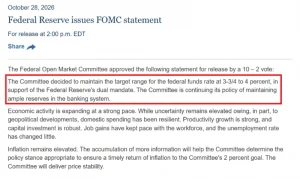
Federal Reserve statement dated 28 October 2026, showing the 3.75%–4.00% target range and the two policymakers who favoured increasing rates. Capture the policy decision and voting paragraphs from the official Federal Reserve announcement.
The inflation data released on 10 November added to these concerns.
The US Bureau of Labor Statistics reported:
- Headline consumer prices increased 0.4% in October.
- Core consumer prices increased 0.3%.
- Shelter costs increased 0.3%.
- Energy prices increased 0.7%.
These figures reinforced concerns that inflation could remain sufficiently persistent to justify further tightening.
Importantly, standard annual CPI comparisons for October 2026 were unavailable for many categories because October 2025 data collection was disrupted by a government funding lapse.
Investors should therefore avoid treating incomplete annual comparisons as confirmed inflation trends.

October 2026 US Consumer Price Index report showing headline inflation of 0.4% and core inflation of 0.3%. Capture the summary paragraphs and relevant rows of Table A from the official Bureau of Labor Statistics report.
Why Are Bitcoin Investors Worried About a December Fed Rate Hike?
The next Federal Reserve monetary policy decision is scheduled for 9 December 2026.
Market participants have increasingly considered the possibility of a 25-basis-point increase, with more aggressive tightening also discussed by analysts.
A basis point represents one-hundredth of a percentage point. Therefore, a 25-basis-point increase would raise a 3.75%–4.00% target range to 4.00%–4.25%.
This matters because further tightening could raise Treasury yields, support the US dollar and discourage leveraged cryptocurrency investment.
However, the size of the announcement is only part of the story. Investors will also assess the Fed’s economic projections and statements about future policy.
A 25-basis-point increase accompanied by reassuring guidance could potentially support Bitcoin more than an unchanged rate accompanied by unexpectedly hawkish commentary.
The market reaction depends on how the decision compares with expectations.
What Are Cryptocurrency Experts Saying About Bitcoin and Fed Policy?
Recent published commentary reveals how quickly market expectations have changed.
Nick Forster, founder of cryptocurrency options platform Derive.xyz, told Forbes in comments published on 12 November 2026 that Bitcoin traders had become considerably more defensive.
According to the options data he described, the probability of Bitcoin finishing above $80,000 by Christmas declined from 53% to 26% within approximately one week.
Meanwhile, the estimated probability of Bitcoin finishing below $70,000 increased from 15% to 31%.
| Bitcoin outcome by Christmas 2026 | Earlier estimate | Updated estimate |
| Above $80,000 | 53% | 26% |
| Below $70,000 | 15% | 31% |
These are market-implied probabilities from a particular options platform, not guaranteed forecasts or independently verified probabilities of future outcomes.
Forster observed that traders were becoming more defensive, with demand for downside protection increasing.
His assessment suggests that changing monetary expectations can influence derivatives positioning before the Federal Reserve announces its decision.
Ranim Turfa, head of research and market analysis at Tickmill, also highlighted the importance of macroeconomic developments in comments reported by Forbes.
Turfa explained that stronger inflation or employment figures could reinforce expectations of tighter policy and extend Bitcoin exchange-traded fund outflows.
Conversely, weaker economic data could help the cryptocurrency stabilise.
These assessments reinforce an important distinction: Bitcoin investors are responding to changing expectations, not simply reacting to completed monetary policy decisions.
Does Bitcoin Always Fall When the Fed Raises Interest Rates?
No. Historical performance shows that the relationship between Federal Reserve policy and Bitcoin is more complicated.
During 2020, the Fed reduced interest rates dramatically as the COVID-19 crisis disrupted financial markets.
Bitcoin initially experienced a severe sell-off, despite the emergency monetary response. It subsequently recovered strongly as financial conditions improved.
During 2022, aggressive interest rate increases coincided with a substantial cryptocurrency bear market. However, major crypto-industry failures, including the collapse of FTX, also contributed to the downturn.
In 2024, Bitcoin experienced significant institutional investment developments alongside changing expectations for interest rates.
Our interpretation of these historical periods suggests that investors must distinguish between monetary policy, cryptocurrency-specific events and broader market conditions.
The Michael Terpin Bitcoin price prediction also demonstrates how market cycle analysis can produce a different outlook from predictions based solely on Federal Reserve decisions.
Neither historical Bitcoin cycles nor interest rate movements provide a reliable standalone forecasting model.
How Do Inflation, Liquidity and the US Dollar Influence Bitcoin?
Three financial mechanisms explain much of Bitcoin’s sensitivity to Federal Reserve policy.
Inflation expectations: Persistent inflation increases the possibility that the Fed will maintain restrictive rates for longer. That can reduce demand for speculative investments.
Financial liquidity: Easier credit conditions may increase investment activity, while tighter conditions can restrict leverage and risk-taking. However, an interest rate cut does not automatically mean the Fed is directly injecting money into cryptocurrency markets.
US dollar strength: Bitcoin is commonly priced in US dollars. A stronger dollar can create pressure on dollar-denominated assets, although the relationship changes across market environments.
Another useful indicator is the real interest rate, which adjusts nominal yields for inflation expectations.
Higher real yields can increase the opportunity cost of holding Bitcoin, which does not itself generate contractual interest payments.
This is particularly relevant when assessing whether Bitcoin is behaving like a speculative technology investment or attracting demand as a long-term store of value.
How Do Bitcoin ETFs and Options Change the Fed’s Price Impact?
The growth of institutional cryptocurrency investment has created additional channels through which monetary policy can affect Bitcoin.
Spot Bitcoin exchange-traded funds allow investors to obtain exposure through conventional securities markets.
When institutional investors become more risk-averse, redemptions and negative ETF flows can contribute to selling pressure. Sustained inflows may instead provide support.
However, ETF flow totals should not automatically be interpreted as identical amounts of immediate Bitcoin buying or selling, because settlement arrangements and trading mechanisms can differ.
Derivatives markets provide another important signal.
Options traders may purchase puts to protect against falling prices or calls to participate in potential gains.
Large positions around particular strike prices can influence hedging activity and short-term volatility.
Our analysis of Deribit Bitcoin and Ether open interest illustrates why options positioning matters when evaluating institutional market sentiment.
During major Fed announcements, the interaction between ETF flows, futures leverage and options hedging can amplify price movements.
Could the Federal Reserve Push Bitcoin Below $70,000?
A decline below $70,000 remains a possible scenario, but it is not inevitable.
The level has attracted attention because recent options positioning reflects increased demand for protection against further declines.
The following scenarios illustrate how the December decision could affect Bitcoin.
| December 2026 scenario | Potential Bitcoin response | Main condition |
| Larger-than-expected rate increase | Stronger selling pressure | Market surprised by tightening |
| Expected 0.25-point increase | Mixed or limited reaction | Decision already reflected in prices |
| Rates unchanged with hawkish guidance | Potential decline | Future hikes remain likely |
| Rates unchanged with dovish guidance | Potential recovery | Lower expected future rates |
| Unexpectedly weak economic data | Volatile, potentially mixed | Recession fears offset rate-cut hopes |
These are conditional scenarios, not probability-weighted price forecasts.
A break below $70,000 would not automatically establish a longer-term bear market. Trading volume, ETF flows, derivatives liquidations and the broader economic environment would help determine whether selling pressure could continue.
Likewise, a recovery above $80,000 would not independently confirm a sustained bullish trend.
What Should UK Bitcoin Investors Consider?
Although Federal Reserve decisions are made in the United States, their consequences extend to British cryptocurrency investors.
Bitcoin is primarily quoted in US dollars, while UK investors frequently measure their holdings in pounds sterling.
This creates an additional currency consideration.
For example, Bitcoin could remain unchanged in dollar terms while its sterling value falls if GBP strengthens against USD.
UK investors should therefore monitor both BTC/USD and BTC/GBP rather than relying exclusively on dollar-denominated market headlines.
Transaction costs are another consideration during volatile periods. Exchange spreads can widen when market activity becomes disorderly.
Comparing cryptocurrency exchange fees can help investors understand how trading costs influence their net results.
Investors who sell Bitcoin following an interest rate announcement should also consider potential UK tax consequences. Our coverage of HMRC cryptocurrency tax warning letters explains why keeping accurate transaction records is increasingly important.
Which Economic Indicators Should Bitcoin Investors Monitor?
Our analysis identifies five indicators that deserve attention alongside the Federal Reserve’s headline rate decision.
| Indicator | Why it matters for Bitcoin |
| Consumer Price Index (CPI) | Influences inflation and interest rate expectations |
| Producer Price Index (PPI) | Provides evidence of price pressures earlier in the supply chain |
| US employment data | Helps determine whether the economy can withstand tighter policy |
| Treasury yields and US dollar | Reflect changing financial conditions |
| Bitcoin ETF flows and options positioning | Reveal institutional demand and risk management |
The October Producer Price Index report is scheduled for release on 13 November 2026 at 8:30 a.m. Eastern Time.
Investors should compare the figures with economists’ expectations rather than judging whether the published numbers appear high or low in isolation.
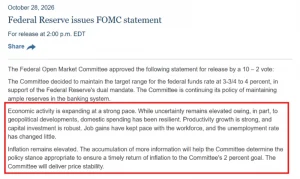
Federal Reserve October 2026 policy statement highlighting its inflation concerns and commitment to returning inflation to 2%. Capture the economic assessment and policy objectives from the official Federal Reserve announcement.
A useful approach is to review inflation data first, examine how rate expectations respond, and then assess Bitcoin market positioning.
This is more informative than assuming every negative economic headline must immediately cause cryptocurrency prices to decline.
How Can Investors Manage Bitcoin Volatility Around Fed Announcements?
Federal Reserve meetings can create sharp movements within minutes, particularly when the announcement differs from market expectations.
For less-experienced investors, avoiding excessive leverage can reduce the risk of forced liquidation.
Maintaining a diversified portfolio, evaluating position sizes and understanding exchange execution costs may also help manage exposure.
Investors planning their first purchase can review how to buy Bitcoin in the UK before choosing an exchange or funding an account.
Long-term investors may prefer a consistent investment approach rather than attempting to predict the exact market reaction to every Fed statement.
Short-term traders, meanwhile, should recognise that stop-loss orders do not guarantee execution at the requested price during sudden market moves.
The objective should be managing uncertainty rather than assuming any single forecast will prove correct.
What Is the Overall Federal Reserve Bitcoin Price Outlook?
The Federal Reserve Bitcoin price impact remains significant heading into December 2026.
Persistent inflation, the possibility of further monetary tightening and more defensive derivatives positioning have increased downside risks.
Nevertheless, the outcome is not determined solely by the next interest rate decision.
The most important variables are how inflation develops, whether the Fed surprises investors, and whether institutional demand can offset tighter financial conditions.
Our assessment is that Bitcoin investors should prioritise economic evidence, monetary policy expectations and observable market positioning over isolated price predictions.
Understanding how these factors interact offers a more useful framework for evaluating Bitcoin’s next major movement.
Frequently Asked Questions
Will Bitcoin increase if the Federal Reserve cuts interest rates?
Lower rates can support Bitcoin by reducing borrowing costs and improving investor appetite for risk. However, if the Fed cuts rates because of a serious economic downturn, Bitcoin could initially decline alongside other risky assets.
Why does Bitcoin sometimes fall before a Federal Reserve meeting?
Cryptocurrency markets respond to expectations. Traders may sell Bitcoin days or weeks before a meeting if inflation data or official comments suggest tighter monetary policy than previously anticipated.
Can Bitcoin reach $100,000 despite higher interest rates?
Yes, it remains possible. Institutional demand, adoption, available supply and wider market sentiment can outweigh interest rate pressure. However, reaching any particular price is uncertain, and higher rates may make sustained appreciation more difficult.
Is Bitcoin a reliable hedge against inflation?
Bitcoin has a limited supply, which supports its long-term scarcity argument. However, its market price has often behaved like a risk-sensitive asset. It should not be treated as a consistently reliable short-term inflation hedge.