




HM Revenue & Customs (HMRC) has intensified its scrutiny of cryptocurrency investors across the UK, issuing 81,172 crypto-related warning letters, emails and text messages during the 2025/26 financial year.
These warnings form part of a wider effort to identify investors who may not have declared taxable cryptocurrency gains or income.
The increase is particularly significant because many people still assume cryptocurrency transactions remain outside the traditional UK tax system.
However, profits generated from selling Bitcoin, Ethereum and other digital assets can attract Capital Gains Tax, while certain crypto rewards and payments may be subject to Income Tax.
For anyone who has received a crypto tax warning letter from HMRC, the important point is that receiving a warning does not automatically mean they have broken the law or owe additional tax.
It does mean their cryptocurrency activity deserves a careful review, particularly if they have sold, exchanged or received digital assets without reporting the relevant transactions.
Why Has HMRC Sent More Than 81,000 Crypto Tax Warning Letters?
HMRC issued 81,172 crypto-related warning communications in 2025/26, compared with 27,714 in 2023/24, according to Freedom of Information figures reported by the BBC on 19 August 2026. The communications included letters, emails and text messages, rather than postal letters alone.
The figures highlight how quickly cryptocurrency tax compliance has become a greater priority for the UK tax authority.
The increase between 2023/24 and 2025/26 was approximately 193%, meaning HMRC’s warning activity has almost tripled in two years.
There are several reasons for the increased attention.
First, cryptocurrency adoption has introduced more people to investment activities that can create tax liabilities. Some investors understand how profits are calculated when selling shares but do not realise that similar principles can apply to digital assets.
Second, cryptocurrency exchanges retain transaction histories and identification records. HMRC can use information obtained through lawful data requests and reporting arrangements to assess whether investors may have undeclared income or gains.
Finally, HMRC is preparing for a broader international system of cryptoasset transaction reporting, which will provide additional information about users of participating platforms.
The increased warning activity does not establish that every recipient has underpaid tax. Rather, it shows HMRC is encouraging more taxpayers to review their cryptocurrency reporting.
What Is an HMRC Crypto Tax Warning Letter?
An HMRC crypto tax warning letter, commonly called a nudge letter, is a communication asking someone to review their cryptocurrency transactions and determine whether they have correctly declared taxable income or gains.
The purpose is generally to encourage compliance before HMRC considers more formal enforcement action.
A warning might be issued when HMRC has information suggesting that an individual has engaged in cryptocurrency activity but cannot establish whether all relevant gains have been declared.
A typical warning may ask the recipient to:
- Review cryptocurrency transactions for particular tax years.
- Check whether any Capital Gains Tax or Income Tax is outstanding.
- Correct inaccurate tax returns where necessary.
- Disclose previously unreported taxable gains.
- Respond by a deadline specified in the letter.
The exact instructions depend on the correspondence received. Some letters simply encourage taxpayers to review their records, while others may request a written response or additional information.
Importantly, an ordinary nudge letter is not the same as a formal tax investigation, a penalty assessment or a demand for payment.
Why Might HMRC Send You a Crypto Tax Warning Letter?
There are several circumstances in which an investor might receive a warning.
You Sold Cryptocurrency Without Reporting Gains
Selling cryptocurrency at a profit can create a Capital Gains Tax liability, depending on your total taxable gains and available allowances.
For example, someone who purchased Bitcoin for £4,000 and subsequently sold it for £12,000 could have an £8,000 gain before allowable costs and reliefs.
If they did not report that gain when required, HMRC may contact them.
You Exchanged One Cryptocurrency for Another
One of the most common misunderstandings is that tax is only relevant when cryptocurrency is converted into pounds.
However, exchanging Bitcoin for Ethereum, XRP or another cryptocurrency generally counts as a disposal for Capital Gains Tax purposes.
Even when no money enters a UK bank account, the transaction may create a taxable gain.
For instance, someone holding XRP should understand the tax implications of buying, exchanging and selling the asset. The rules are also relevant when considering how to buy XRP in the UK.
You Received Cryptocurrency Rewards
Some cryptocurrency earnings may be subject to Income Tax rather than Capital Gains Tax when received.
These can include certain mining rewards, staking rewards, employment payments and DeFi income.
For investors exploring how cryptocurrency staking works, the distinction matters because receiving rewards and disposing of them later can have separate tax consequences.
HMRC Has Information From an Exchange
Cryptocurrency platforms may hold customer identification details and transaction information that can be used in compliance checks.
Information about an account does not necessarily establish that tax is owed. However, it can lead HMRC to investigate possible differences between reported tax information and investment activity.
Which Cryptocurrency Transactions Are Taxable in the UK?
Not every cryptocurrency transaction creates a tax liability.
The tax treatment depends on the transaction, ownership of the assets, income received and the taxpayer’s circumstances.
| Crypto activity | Usual UK tax treatment |
| Buying Bitcoin with pounds | No Capital Gains Tax simply for buying |
| Holding Bitcoin without selling | No Capital Gains Tax simply for holding |
| Selling Bitcoin for a profit | Potential Capital Gains Tax |
| Swapping Bitcoin for Ethereum | Potential Capital Gains Tax |
| Using crypto to purchase goods | Potential Capital Gains Tax |
| Transferring crypto between wallets you own | Normally no Capital Gains Tax if beneficial ownership does not change |
| Receiving staking rewards | Potential Income Tax |
| Receiving mining rewards | Potential Income Tax |
| Giving cryptocurrency to someone | Potential Capital Gains Tax, subject to applicable exemptions |
| Selling cryptocurrency at a loss | An allowable capital loss may be claimable |
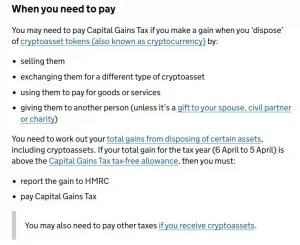
HMRC confirms that disposals can include selling cryptoassets, exchanging them for another type of token, using them to make purchases and making certain gifts.
Further details are available in the official HMRC guidance on Capital Gains Tax for cryptoassets.
How Much Crypto Tax Could You Owe HMRC in 2026?
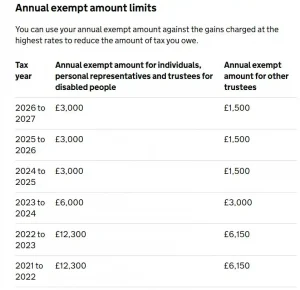
For the 2026/27 tax year, the Capital Gains Tax annual exempt amount for most individuals is £3,000.
This means individuals generally pay Capital Gains Tax on relevant net gains exceeding their available annual exemption, after accounting for allowable losses and reliefs.
For most personal cryptocurrency investment gains, the applicable Capital Gains Tax rates are:
| Taxpayer’s applicable CGT band | 2026/27 rate |
| Gains falling within the unused basic-rate band | 18% |
| Gains above the basic-rate band | 24% |
The rate depends on taxable income and the amount of taxable gains. A person may pay both rates on different portions of their gains.
Example: Calculating Tax on Cryptocurrency Profits
Consider a hypothetical UK investor who makes the following transaction during the 2026/27 tax year.
| Transaction detail | Amount |
| Cryptocurrency purchase price | £4,000 |
| Cryptocurrency selling price | £10,000 |
| Allowable transaction fees | £100 |
| Capital gain | £5,900 |
| Annual exempt amount | £3,000 |
| Taxable capital gain | £2,900 |
Assuming the investor has no other gains or losses affecting the calculation and can use their entire annual exemption:
- At 18%, the estimated Capital Gains Tax is £522.
- At 24%, the estimated Capital Gains Tax is £696.
This example demonstrates why cryptocurrency investors should calculate taxable gains instead of assuming that the full selling value is taxed.
The example also assumes the straightforward acquisition cost is appropriate. Actual calculations may require HMRC’s same-day, 30-day matching and pooling rules.
What Should You Do After Receiving an HMRC Crypto Tax Warning Letter?
Receiving an HMRC warning should prompt a careful review rather than an immediate assumption that additional tax must be paid.
The following process can help recipients establish the correct position.
HMRC crypto warning response checklist
1. Check Whether the HMRC Letter Is Genuine
Before sharing personal information or making a payment, verify the communication.
Scammers can impersonate government departments and use threats about unpaid taxes to pressure cryptocurrency investors.
Warning signs include unexpected requests for wallet seed phrases, demands to transfer cryptocurrency to a wallet address, suspicious payment links or urgent threats of arrest.
HMRC provides a searchable list of genuine communications on GOV.UK. Recipients can also contact HMRC through independently verified contact details.
A related example of how fraudsters impersonate trusted financial platforms is explained in this guide to Binance scam text messages.
2. Review Your Cryptocurrency Transaction History
Download available transaction records from every exchange and wallet used during the relevant tax years.
Include purchases, sales, swaps, staking rewards, transfers, transaction fees and relevant DeFi activity.
Transactions must be classified correctly. For example, transferring cryptocurrency between two wallets owned by the same individual is usually not a taxable disposal where beneficial ownership remains unchanged.
Investors who have previously moved cryptocurrency from Coinbase to another wallet should distinguish such transfers from genuine sales or exchanges.
3. Calculate Your Gains and Income
Calculate capital gains separately for the relevant tax years using the correct historic allowances and tax rates.
For disposals, HMRC generally requires investors to account for acquisition costs, proceeds, allowable expenses and the appropriate token-pooling rules.
Cryptocurrency values must be converted into pounds sterling for UK tax reporting.
Do not rely exclusively on the profit figure shown by a single exchange. That platform may not have information about purchases or transfers conducted elsewhere.
4. Check Previously Submitted Tax Returns
Compare your calculations against any Self Assessment returns already submitted.
HMRC introduced a dedicated cryptoasset section in Self Assessment returns from the 2024/25 tax year onwards. This is intended to make relevant cryptoasset reporting more explicit.
If you discover that a return contains errors, determine whether it can still be amended through Self Assessment or whether another disclosure procedure is required.
5. Respond Within the Required Timeframe
Read the exact instructions in the warning letter.
If HMRC requests a response within a particular number of days, record the deadline and avoid missing it.
If calculations are incomplete or you need more time, contact HMRC using verified details to discuss the circumstances.
Do not sign a statement confirming that your cryptocurrency tax affairs are correct unless you have carried out the necessary checks.
What Happens If You Ignore an HMRC Crypto Tax Warning Letter?
Ignoring a genuine warning can increase the risk of further HMRC contact or a formal compliance investigation.
Although receiving a nudge letter does not establish wrongdoing, HMRC may pursue a case if the information available to it suggests that taxable activity remains unreported.
Potential consequences include additional enquiries, assessments for unpaid tax, interest and penalties where the legal conditions are met.
HMRC’s guidance explains that penalties may reach 100% of unpaid tax in relevant circumstances, with potentially higher penalties for certain offshore matters. The actual penalty depends on the conduct involved and the applicable legislation.
There is no automatic fixed penalty simply for receiving a crypto nudge letter.
How Many Years Can HMRC Investigate Unpaid Crypto Tax?
The period for which unpaid tax may need to be disclosed depends partly on the reason it was not paid.
HMRC’s Cryptoasset Disclosure Service sets out the following general periods.
| Reason for unpaid tax | General look-back period |
| Reasonable care was taken | Up to 4 years |
| Failure to take reasonable care | Up to 6 years |
| Deliberate non-disclosure | Up to 20 years |
These are general disclosure periods, and the applicable statutory assessment limits may depend on the circumstances.
For example, a taxpayer who made a genuine mistake despite taking reasonable care may be treated differently from someone who knowingly concealed taxable cryptocurrency income.
A warning letter does not establish deliberate behaviour.
How Can You Disclose Unpaid Cryptocurrency Tax to HMRC?
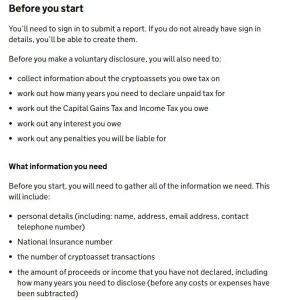
HMRC operates a dedicated Cryptoasset Disclosure Service for people who have identified unpaid tax relating to previous tax years.
The service can be used for unpaid tax involving cryptocurrency, NFTs and other qualifying cryptoassets.
The general process involves gathering transaction records, calculating unpaid tax, working out interest and any applicable penalties, and submitting the disclosure through HMRC’s online service.
HMRC says that after receiving a disclosure, it will issue a payment reference. Payment must normally be made within 30 days of submitting the disclosure. If payment is not affordable, the taxpayer should contact HMRC to discuss their options.
The official process is explained in HMRC’s guidance on disclosing unpaid cryptocurrency tax.
Importantly, HMRC distinguishes older unpaid liabilities from reporting income and gains for the current or previous tax year, which may need to be included on a Self Assessment return instead.
What If You Receive an HMRC Warning but Do Not Owe Any Crypto Tax?
Receiving a letter does not necessarily mean additional tax is payable.
Someone may have purchased cryptocurrency but never sold it, transferred tokens between personally owned wallets or realised gains that fall within their available annual exemption.
Others may have already declared the relevant gains correctly.
If no tax is due, the recipient should retain evidence supporting that conclusion and respond according to the instructions in the communication.
A useful explanation may describe the tax years reviewed, the types of transactions undertaken and why no further tax liability arose.
Where appropriate, supporting documents could include exchange transaction reports, wallet histories or capital gains calculations.
The important distinction is between demonstrating that no tax is due and simply assuming that no tax is due because no money was withdrawn to a bank account.
How Will the New Crypto Reporting Rules Affect HMRC Warnings in 2027?
The UK’s Cryptoasset Reporting Framework (CARF) introduces more systematic reporting of cryptocurrency activity.
From 1 January 2026, reporting cryptoasset service providers within scope are required to collect relevant customer identification and transaction information.
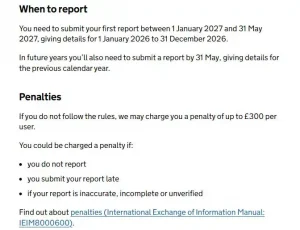
The first reporting period covers 1 January to 31 December 2026, with reports due by 31 May 2027.
This means the collection of information began in 2026, but the first annual reports under the new framework are due in 2027.
For individual investors, this is significant because HMRC will be better placed to compare reported tax information against data supplied by participating platforms.
However, the system does not mean every transaction is taxable or that every crypto investor will automatically receive a warning.
The reporting requirements primarily apply to relevant service providers. Individual taxpayers remain responsible for assessing and declaring their own taxable gains and income.
When Is the Next Cryptocurrency Tax Reporting Deadline?
For taxpayers reporting crypto gains or income through Self Assessment, the relevant deadline depends on the tax year.
| Tax year | Online Self Assessment deadline |
| 2024/25 | 31 January 2026 — passed |
| 2025/26 | 31 January 2027 |
| 2026/27 | Normally 31 January 2028 |
For the 2025/26 tax year, the standard registration deadline for new Self Assessment taxpayers was 5 October 2026.
Someone registering after that date may receive a different filing deadline from HMRC, but the standard tax payment deadline remains 31 January 2027.
Anyone reviewing older cryptocurrency activity should establish which return deadlines, amendment periods and disclosure procedures apply to each tax year.
Frequently Asked Questions
Does an HMRC Crypto Tax Warning Letter Mean I Am Under Investigation?
Not necessarily. A nudge letter is generally intended to encourage a taxpayer to review their position. A formal compliance investigation is a separate process.
Can HMRC See My Coinbase or Binance Transactions?
HMRC may obtain relevant customer and transaction information through lawful information requests and applicable reporting arrangements. It should not be assumed that every exchange transaction is automatically visible.
Do I Need to Pay Tax If I Never Withdrew Cryptocurrency to My Bank Account?
Possibly. Exchanging one cryptocurrency for another can trigger a taxable disposal, even without withdrawing pounds.
Can HMRC Charge Penalties for Cryptocurrency Profits From Previous Years?
Yes, where unpaid tax and the relevant legal conditions exist. Interest and penalties may apply, with the treatment depending on factors including the taxpayer’s behaviour and disclosure circumstances.
Can I Receive a Warning Letter Even If My Cryptocurrency Investment Made a Loss?
Yes. HMRC may contact someone about their cryptocurrency activity before establishing their actual taxable position. Properly calculated losses may demonstrate that no Capital Gains Tax is due.
Is Transferring Crypto Between My Own Wallets Taxable?
Normally not, provided beneficial ownership remains unchanged. However, arrangements involving DeFi protocols or a change in beneficial ownership may require separate analysis.
Will Hmrc Automatically Know About My Cryptocurrency Profits in 2027?
New reporting requirements will provide HMRC with more information about participating service providers’ customers and activity. They do not guarantee that HMRC will have a complete tax calculation for every investor.